A rocket is one block of fixed liftoff mass. Rocket Tailor lets you decide where the seams between its stages go and what each stage burns, and shows how much cargo that cut carries, the moment your finger moves.
You have seen the stream: a rocket the height of a building, a satellite the size of a van on top. Why so big, and why cut into pieces? Rocket Tailor answers by letting you do the cutting. No parts catalogue, no joystick, no formulas to type. One decision, made well or badly, with the result in kilograms.
What you do in it
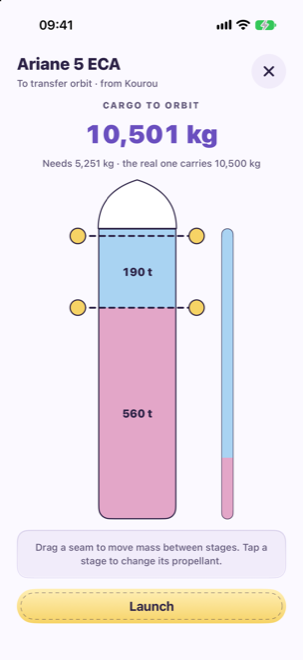
Drag the seams
Move mass between stages and pick kerosene, hydrogen, methane, solid or storable propellant. The cargo figure follows your finger.
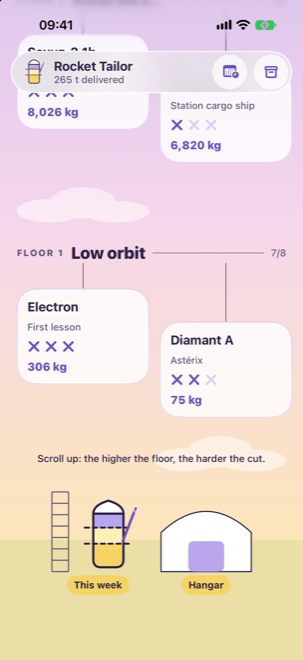
Forty real missions
Five floors of sky, from Diamant and Black Arrow to Saturn V, Ariane and the James Webb Space Telescope, each built on a real vehicle.
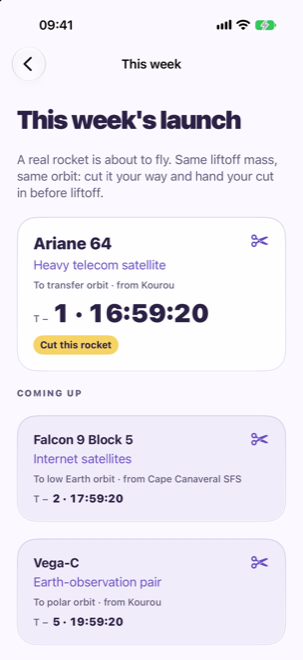
This week's launch
The next real launch becomes a level, with its liftoff mass and orbit. Hand your cut in before the countdown ends; the card is stamped once it has flown.
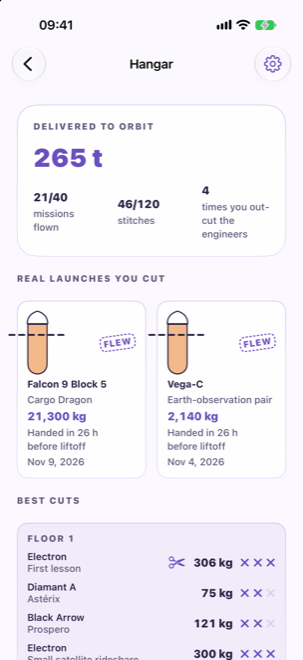
Out-cut the engineers
Lay your cut beside the one that really flew and read why the engineers chose theirs. Three stitches when you match or beat it.
How it looks
An honest model
The game runs a small, deterministic model of the rocket equation on your iPhone, calibrated so that each vehicle's real split delivers its published cargo on its reference orbit. Boosters count as a stage, reuse is ignored. The numbers point the right way; they are not engineering data, and the app says so.
Your data, briefly
No account, no ads, no purchases, no tracking. Your progress stays on your iPhone. Notifications only if you allow them.
The app reads the public launch schedule and checks once per launch whether a newer version exists; it sends no personal data with either.
A message you write in Help and feedback goes to our team by email, only when you press Send.